Guide
Tasmania tours: how many days do you need?
How long to spend on a Tasmania tour: what fits into four, seven, ten and fourteen days, guided tours compared with self-drive, getting to Tasmania by air or ferry, driving times between the main regions, seasons and how to plan around weather and wildlife.
Published
Tasmania looks small on a map of Australia, which tempts visitors to rush it. In reality, its roads are winding, its weather changes quickly, and its best places reward slow travel. This guide explains how many days to allow for a tour of Tasmania, what fits into different trip lengths, and whether to take a guided tour or drive yourself.
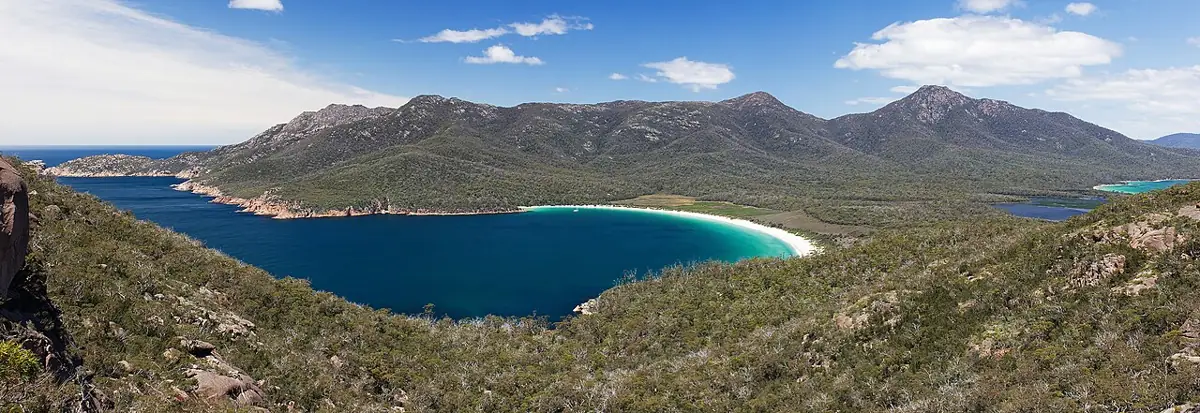
Photo: Wineglass Bay from Lookout crop.jpg by JJ Harrison (https://www.jjharrison.com.au/), CC BY-SA 3.0, via Wikimedia Commons.

We do not sell tours or quote prices. Check current details with operators, Parks and Wildlife Service Tasmania and Discover Tasmania before you travel.
Quick answer
- 4 days: one region, usually Hobart and its day trips.
- 7 days: Hobart, the east coast with Freycinet, and Cradle Mountain at a brisk pace.
- 10 days: the classic highlights with time to walk and slow down.
- 14 days: a full loop including the wild west coast.
Getting to Tasmania
Most visitors fly into Hobart or Launceston from mainland cities. The alternative is the Spirit of Tasmania ferry across Bass Strait between Geelong in Victoria and Devonport on Tasmania's north coast, which lets you bring your own car. The crossing takes most of a day or a night, so count it as a travel day in your plan.
Many guided tours start and finish in Hobart; some run one-way between Hobart and Launceston.
Driving times between the main regions
Distances are short by mainland standards, but roads wind through hills and forests, and wildlife is common on roads at dawn and dusk. The table gives broad guides only.
| Route | Rough driving time |
|---|---|
| Hobart to Port Arthur | About 1.5 hours |
| Hobart to Freycinet (Coles Bay) | About 2.5 to 3 hours |
| Freycinet to Launceston | About 2.5 hours |
| Launceston to Cradle Mountain | About 2 hours |
| Cradle Mountain to Strahan | About 2 to 2.5 hours |
| Strahan to Hobart | About 4 to 5 hours |
Times exclude stops. Transport Tasmania advises visiting drivers to take breaks and avoid driving at night in rural areas where possible.
What fits into four days
Four days suits a single base, usually Hobart. A typical short tour or self-planned stay might include:
- Hobart's waterfront, Salamanca Place and its Saturday market
- kunanyi / Mount Wellington for views over the city
- a day trip to Port Arthur Historic Site and the Tasman Peninsula
- a day on Bruny Island for coastal scenery, wildlife and local produce
- or the Huon Valley and Mount Field National Park
You could instead spend four days on the east coast, but trying to add Cradle Mountain makes the trip feel rushed.
What fits into seven days
A week allows a short loop through the most famous regions:
- Days 1 to 2: Hobart and one day trip.
- Days 3 to 4: the east coast, with Freycinet National Park and Wineglass Bay.
- Day 5: north to Launceston and the Tamar Valley.
- Days 6 to 7: Cradle Mountain, then return to Launceston or Hobart.
This is the shape of many one-week guided tours. It works, but there is little slack for bad weather on Cradle Mountain or a long walk at Freycinet.
What fits into ten days
Ten days is the length we recommend for a first visit. It covers the same highlights as a week with room to breathe: two nights at Freycinet, two at Cradle Mountain, and an extra day for Bruny Island, the Bay of Fires or the Tamar Valley. Our Tasmania 10 days itinerary sets out a day-by-day version.
What fits into fourteen days
Two weeks lets you complete a full loop, including the west coast:
- Strahan and a Gordon River cruise into the Tasmanian Wilderness World Heritage Area
- the West Coast Wilderness Railway
- the Lake St Clair end of the Overland Track country
- the remote north-west, such as Stanley and the Tarkine (takayna)
The west is wetter and quieter. It is where Tasmania feels most like wilderness, and it is often the part of the island people wish they had allowed more time for.
Guided tour or self-drive?
| Factor | Guided tour | Self-drive |
|---|---|---|
| Driving | None; guide drives winding roads | You drive, including at dusk |
| Flexibility | Fixed itinerary | Change plans for weather |
| Interpretation | Guide explains history and nature | You research yourself |
| Solo travellers | Easy company, no single driving | Can be lonely and costly |
| Walks | Guided walks with safety support | Choose your own, carry your own gear |
Many travellers combine both: a self-drive with a guided walk at Cradle Mountain, a Bruny Island food tour or a cruise. Multi-day guided walks, such as those on the Overland Track or around Freycinet, are a specialist category with their own fitness requirements.
When to go
Tasmania has four distinct seasons.
- Summer (December to February): the warmest weather and longest days, and the busiest time.
- Autumn (March to May): settled weather and autumn colour, including the native deciduous beech (fagus) in the highlands around late April.
- Winter (June to August): cold, with snow possible on Cradle Mountain and kunanyi, short days and fewer crowds.
- Spring (September to November): wildflowers, lambs and changeable weather.
In any season, pack layers and a waterproof jacket. Highland weather can turn from sunshine to sleet in an afternoon.
Park passes
You need a park pass to visit Tasmanian national parks such as Freycinet, Cradle Mountain-Lake St Clair and Mount Field. A holiday pass covering a set number of weeks suits most visitors. Guided tours often include passes, so check your inclusions first.
Wildlife and safety
Tasmania is one of the best places in Australia to see wildlife, including wombats, pademelons, wallabies and, with luck, Tasmanian devils. That also means animals on roads at dawn and dusk. Slow down, and avoid driving in rural areas at night where you can.
Planning your tour
Decide your number of days first, then choose a base or loop that fits. If you have a week or less, focus on the east and Cradle Mountain. If you have ten days or more, add the west. Compare tours using our operator checklist, and see the Tasmania destination page for more on each region.
Frequently asked questions
How many days are recommended for a tour of Tasmania?
Seven to ten days covers the main highlights, including Hobart, the east coast and Freycinet, and Cradle Mountain, at a comfortable pace. Four days suits one region; fourteen days allows a full loop including the west coast.
Is four days enough in Tasmania?
Four days is enough for Hobart and nearby day trips such as Bruny Island, Port Arthur or Mount Wellington (kunanyi), or for a short east-coast trip. It is not enough to see the whole island.
Is it better to self-drive or take a tour in Tasmania?
Tasmania suits self-drive well because distances are manageable and main roads are sealed. Guided tours are a good choice if you prefer not to drive on winding roads, want expert interpretation, or are travelling alone.
What is the best month to visit Tasmania?
Summer and early autumn bring the warmest weather and longest days. Autumn is popular for colour, and winter brings snow to the highlands. Weather can change quickly in any season.
Do I need a park pass in Tasmania?
Yes. A park pass is needed to enter Tasmanian national parks such as Freycinet, Cradle Mountain-Lake St Clair and Mount Field. Tours often include passes; check before buying one.